
Why Student-Centered Design Matters at Venture Academy
Why Student-Centered Design Matters at Venture Academy
From the onset, Venture Academy has continually worked to design a student-centered classroom and overall school experience. This may sound obvious for any school, and it is, but unfortunately, many schools are designed with adult professionals in mind. Starting with the student has shaped Venture’s philosophy, curriculum, technology, teacher training, furniture, and now the new building. How do we design a building to foster collaboration, empathy, curiosity, critical thinking, and many more future-focused skills that our students will need to thrive in a rapidly changing world?
Venture’s approach has moved away from the traditional “factory model,” a product of the Industrial Revolution. Within the factory model, the traditional classroom is compared to the original one-room schoolhouse. In 1840, the educator Horace Mann conceived of combining these single schoolhouse classrooms into a single structure. This concept remains the basic Design DNA for most schools built today, 186 years later! An antiquated design approach such as this no longer supports the development of skills, competencies, and behaviors essential for students to succeed in a rapidly changing AI-driven world.
In broad terms, Venture’s student-centered model consists of a collection of collaborative learning studios. At the center is a shared Learning Commons, which allows for teaming, cross-disciplinary learning, and student-directed learning. The Learning Commons serves as a connection space between studios, while accommodating both small and large group meeting rooms on both floors. Furniture and technology are flexible, adapting to suit the needs of every student and the grouping.
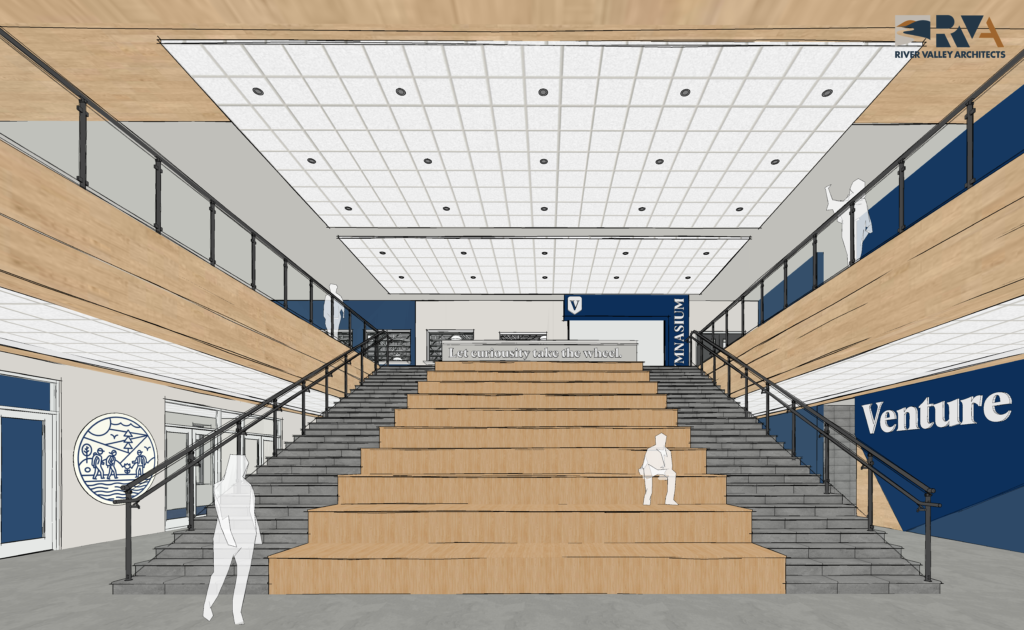
Countless studies over the past decade have pointed to a direct correlation between student and staff wellness and exposure to natural light and the outdoors. The benefits range from increased motivation and reduced stress and anxiety to improved problem-solving and creativity. The new facility is designed to maximize natural light in the 50-acre site’s natural setting. High ceilings in the Learning Commons and general Commons areas contribute to a sense of wonder and enhance creativity. They play a crucial role in learning performance according to a study by Harvard University. An abundance of glass in the studios and Learning Commons provides a visual connection for students and helps reduce anxiety.
The main Commons and Learning Stairs are designed to facilitate connection, comfort, and a sense of community. Recent research from Steelcase (2024) suggests that students are drawn to spaces that resemble a coffee shop, offering a variety of seating options that provide them with a choice. Acoustics and lighting reduce sensory overload and make the space a more human-scale experience
These are just a small sample of the student-centered design efforts underway today and for the future at Venture Academy.
Latest posts:
Venture in the News : Venture Ce...
